
Review by Robert Lyman in The War Room, February 2025 (https://robertlyman.substack.com)
The British Army has produced a remarkable array of soldier-scholars over the years. Lieutenant General Sir John Kiszely is one of these. His meticulous examination of the Norway Campaign of 1940 showed the weakness of the British Army’s approach to campaign planning, and its embarrassing inability to execute a half competent military operation on a distant shore. His study is a brilliant examination of the constituent parts of military failure, the existential experience poor armies seemingly have to experience before they hope to improve.
In this book Kiszely demonstrates his forensic talent in presenting to us a man who sat at the heart of Churchill’s Cabinet and decision-making process throughout the war, but who hid his light under a bushel to the extent that his name has been almost entirely erased from the popular memory of these times: Major General ‘Pug’ Ismay. In this revealing book Kiszely shows us a new side to the decision-making process of the war, through the revealing perspective of an insider who was uniquely placed to record and influence the great events of the war. He wore, simultaneously, a series of hats that makes it remarkable that he has been all but ignored by historians. He was Churchill’s chief of staff, head of his secretariat, deputy military secretary to the War Cabinet, and a member of the Chiefs of Staff Committee. He was, therefore, at the beating heart of Britain’s war machinery. It is impossible to understand how the decision-making of the war was conducted without appreciating the role he played. Kiszely has given us this full orbed and hitherto unappreciated portrait of a key member of the Churchill and the Chiefs of Staff’s thinking apparatus.
Who was Ismay in all this? He was a cog in a complex machinery that, though rarely seen and often prosaic, was nevertheless indispensable for all that. Kiszely’s genius has been to uncover this cog and to reveal the role he held behind the scenes in the war’s decision-making machinery. He was commissioned into the Indian Army and enjoyed his fair share of adventures as a young officer, but in middle rank found his metier as a thinker and coordinator of high level planning. Before long he was an indispensable companion to important committees, Secretaries of State and a single Prime Minister – Winston Churchill. In this role he acted as the dispenser of healing balm, a smoother of ruffled feathers. No matter how cross he became privately with this matter or that (and on one occasion he proffered his resignation to Churchill), on the outside he remained a paragon of amity and calm. An Army officer, he liked and got on well with Americans, as well as with officers of the RAF and Royal Navy, appreciating their perspectives in a way alien to more prejudiced men. It was in his close relationship with Winston Churchill that he will be remembered, as with the bond he cemented with General Dwight Eisenhower. Keeping both men calm, and working together on parallel tracks was his primary duty, a task he achieved with classic self-effacement. It wasn’t easy, and Ismay felt fit to burst on occasions. But he stood firm, despite being tossed to and fro by his oftentimes intemperate boss and by challenges sometimes seemingly too difficult to resolve. By no means perfect he was nevertheless a brilliant man, in the right place at the right time. He had a broad, fast and capable brain. If any of Churchill’s generals can be credited with winning the war, it was Ismay. Kiszely has given us a careful, intelligent and illuminating of this great man. We should collectively be ashamed that his name is not better known.
————————————-
Reference by Andrew Roberts in Aspects of History, Recommended Summer Reads https://aspectsofhistory.com/2024-summer-reads-from-aspects-of-history/
a model biography...it combines scholarly research with first-class writing.
——————————–
Review by Professor Brian Holden Reid in Royal United Services Institute Journal (Issue 169, November 2024)
Over the past half century, General Lord Ismay, always known as ‘Pug’, has been the forgotten man involved in the higher direction of the British war effort in the Second World War. Sir John Keegan admitted that he blundered by overlooking him for inclusion in his edited work, Churchill’s Generals (Weidenfeld & Nicolson, 1991) – indeed, he did not even merit an entry in the index. Ismay was chief of staff to the prime minister and minister of defence, Winston Churchill, head of his secretariat, deputy secretary (military) to the War Cabinet, and sat on the Chiefs of Staff Committee. He ran the machinery through which Churchill directed the war. He was also a powerful force who promoted amity in the Anglo-American alliance. He was the ultimate ‘Churchill’s General’. At long last, General John Kiszely has provided the authoritative, well-researched and informed biography that Ismay deserves, granting him his due without being uncritical. Kiszely ‘aims to assess what Ismay was and what he was not, to provide a portrait of him and place him in the context of his time’ (p. xix).
Ismay was a man who could be easily underestimated. He seemed an unlikely figure to exercise such power. He was born in India in 1887 into a family of Indian civil servants who disapproved of his desire to join the Indian cavalry. In 1904, he was commissioned from Sandhurst into the 21st Prince Albert Victor’s Own Cavalry (Daly’s Horse). Ismay appeared as a jovial, self-effacing, polo-loving subaltern; but he was clever and read a lot, although he concealed his knowledge, for he abhorred a ‘show-off’. His command experience was meagre. He transferred into the Camel Corps in 1914, and although he revealed leadership qualities, he spent the First World War in a low-profile theatre, pursuing the ‘Mad Mullah’ around Somaliland. But he demonstrated exceptional talent as a staff officer. His Quetta Commandant’s Report (1922) is included among the book’s appendices. He passed out first with the rare accolade of an ‘A’ grade.
Another rare quality he displayed was an ability to befriend and work well with officers from the other two services. In 1924, he attended the RAF Staff College (then at Andover) and befriended John Slessor, a future marshal of the RAF. Indeed, it was through RAF influence that, in 1926, he was appointed assistant secretary of the Committee of Imperial Defence (an ad hoc government body that sought to bring some coordination to defence issues), working for the eagle-eyed and meticulous bureaucrat and powerbroker, Sir Maurice Hankey. In 1935, Hankey promoted him to deputy secretary: ‘my days of real soldiering were over’ (p. 41). Henceforth the corridors of power were his true habitat.
With his sure historian’s instinct, Kiszely’s research has revealed that The Memoirs of Lord Ismay (Heinemann, 1960) can seriously mislead. Ismay became preoccupied with not upsetting anybody, especially Churchill, after the uproar that had greeted the publication of Lord Alanbrooke’s diaries by Sir Arthur Bryant in two volumes in 1957 and 1959. Bryant presented Alanbrooke as the guiding genius behind Britain’s victory. Accordingly, in Ismay’s version, reflecting his own modest, forbearing and emollient character, everybody admired their colleagues, all pulled together in the common cause, and any clash of egos was covered by a cloak of discretion. This view neatly fitted British mythology as to how war in 1939–45 was fought. But it did not reflect how Ismay, and many others, felt at the time.
Hankey, for instance, disliked Churchill and remained loyal to Neville Chamberlain. Kiszely makes clear that Ismay inherited this prejudice, but the latter increasingly believed that the slow pace of decision-making during the crises of 1938–39 was quite unsuited to modern warfare. Ismay’s reputation was made by his work on the ‘War Book’ that would effect the transition from peace to war.
With Chamberlain’s resignation, Ismay, like Sir John Colville, survived Churchill’s purge of the ‘ancien régime’. Despite his reservations, Ismay and Churchill bonded during the great crises of 1940, and especially the five trips that they made to France, 10 May–13 June. Ismay also approved of the changes that Churchill made to the wartime machinery. But he soon grasped that although the system was more centralised, streamlined and dynamic, it encouraged confrontation. Ismay’s appointment to the Chiefs of Staff Committee put him in an awkward position, given his lack of service responsibility and comparatively junior rank (not promoted to full general until 19 May 1944). He did not wish to be viewed as Churchill’s ‘stooge’. A great weight was thus placed on Ismay’s political skill, diplomacy, ‘superhuman patience’ (p. 186) and pragmatism. But even he found Churchill’s explosive temper trying. At the Quebec Conference in September 1944 – an action not mentioned in his memoirs – Ismay resigned. When pushed into a corner, Churchill often turned on the beguiling charm: ‘don’t write me this sort of rubbish, dear Pug; we are going to the end – together – you and I’ (p. 158). He withdrew the resignation. Ismay was incredibly resilient, and he did not succumb – although he came near to it.
The other area where Kiszely underlines Ismay’s contribution is the nurturing of the Anglo-American alliance. Here, despite the rhetoric surrounding the ‘special’ relationship, the 1939–45 generation of senior British generals was at a disadvantage compared with their predecessors of 1914–18. Not one of them had visited the US before war broke out and their knowledge of the country was negligible (even Douglas Haig went to the US before 1914). Ismay’s wife was American, but he did not cross the Atlantic until June 1942. Yet his instinctive feel for the country and sensitivity in dealing with American military leaders served him well. The majority of British generals expressed a sarcastic anti-Americanism and adopted a lofty air of superiority. Ismay transcended this prejudice. Adroit at reaching compromises, Ismay’s drafting skills also proved invaluable in keeping the peace.
Ismay, moreover, provided Dwight D Eisenhower with invaluable support. They resembled one another in lacking high-level command experience and being staff officers par excellence. Ismay intervened in 1942 with the dour and uncooperative Kenneth Anderson in North Africa (and redrafted his command directive), and also fended off the criticisms of Brooke and Bernard Montgomery in 1944–45. Ismay deployed an argument that he found useful when he became secretary general of NATO (1952–57): Eisenhower, as the supreme commander, did not need command experience as a coalition leader. He needed superb strategic sense and alert political skills – and these Eisenhower had in spades. Eisenhower repaid Ismay with a warm, lifelong friendship.
Kiszely’s masterly biography includes detailed coverage of Ismay’s post-war career, as what he later termed ‘a sort of chief of staff’ (The Memoirs of Lord Ismay, p. 410) to Lord Mountbatten during the partition of India in 1947, as chairman of the Festival of Britain Council, secretary of state for Commonwealth relations (1951–52), as well as NATO secretary general. In the latter post, ‘keeping the show on the road was a top priority’ (p. 289). He did this by ‘selling’ the Alliance. Ismay’s other main priority, navigating a way through the minefield associated with West German accession to NATO membership, was successfully solved in 1955.
Kiszely’s book is written with style and panache. In a judicious summing up of Ismay’s achievement, he emphasises his subject’s extraordinary diligence (a quality he shared with Hankey). Ismay once compared himself to the ‘poor little donkeys’ he used to see in India carrying massive loads: ‘I feel just like one’ (p. 78). But his duties were willingly borne. Kiszely also concedes that there is a lot about Ismay that is ‘quite ordinary’. But the whole was greater than the sum of the parts. It enabled him to render an extraordinary performance in a whole series of challenging jobs. These were all discharged with aplomb as ‘a case study’ in effective civil–military relations when executing government policy in wartime (p. 315). Quite simply ‘Pug’ Ismay remained the indispensable man not only in the higher direction of the war effort, but for long after.
—————————–
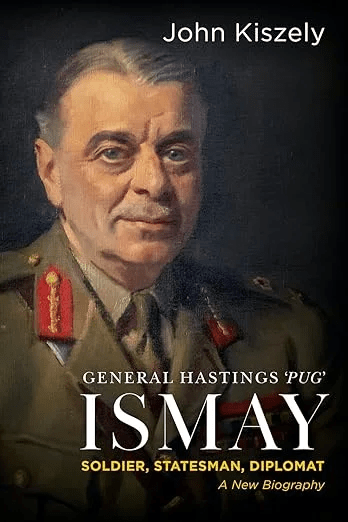
Review by Professor Andrew Stewart in British Army Review September 2024
Who was Hastings ‘Pug’ Ismay? General John Kiszely’s fascinating book aims to put some much needed light on one of the most important military politicians of the 20th century, a key individual long known and admired by this reviewer but who – to use the author’s own words – “is almost always portrayed as a background figure – part of the furniture – and in documentaries and films sometimes gets a walk-on part but almost never a speaking one”. This exceptionally well written and researched biography does much to hopefully expose his remarkable career to a wider audience and correct the lack of visibility Ismay may previously have received, albeit a level of obscurity both during his life and since that was very much of his own making.
Ismay did produce an autobiography, published five years before his death in December 1965, only ten months after the passing of the figure with whom he is most closely associated, Winston Churchill. Almost without exception, this was dismissed for not making any great contribution to popular knowledge, a criticism not about how it was written but because of the discretion it demonstrated. As one reviewer put it, throughout Ismay remained “predictably and infuriatingly modest”. The Times Literary Supplement went further lamenting an absence “of lurid revelations and salon gossip”. As the anonymous writer concluded: “Least said, soonest mended, must be the motto of one whose life is spent in averting or smoothing out rows. But it is not a quality which makes for informative history.” The result was an account that did not contribute a great deal to what was known about how the war was fought and won.
Readers in 1960 were still interested in the Second World War, a war which still held many secrets, and there was perhaps reasonable ground to hope that Ismay had much to offer. His role, or rather four interlocking roles, from 1940 to its conclusion had been to act as both a bridge between the civilian and military strands of the war effort and an anchor. For those interested in understanding the complexity of civil-military relations, and how this often-complicated connection works, they could do worse than using him as a case study. The author makes this same point about the focus of his study and the approach he adopted to “the effective translation of government policy into action in time of war or crisis”.
Perhaps most important amongst the multiple hats Ismay wore was that of chief staff officer to the Minister of Defence, a ministerial position Churchill had created for himself and to which the military Chiefs of Staff reported directly. It was new and critically important to how this particular war would be conducted but it was an often tempestuous workplace environment and it was not an easy job for Ismay. There are 19 index references to ‘Chiefs of Staff Committee – disputes with Churchill’ and the book offers considerable evidence to confirm just how hard he had to work to keep the machine ticking. One of his obituaries referred to “an almost uncanny skill for smoothing over difficulties and averting friction”. Lieutenant General Sir Ian Jacob – another member of the inner circle which surrounded the wartime prime minister – went further, writing to The Times that “Churchill’s unorthodox and often dangerous impulses were cushioned, and his tremendous energy and fertility of ideas found a channel though which they could usefully flow to vitalise the whole national effort” (unimaginable criticism of the wartime prime minister had he still been alive). Elsewhere, Ismay’s close friend wrote that he “took the knocks from above and below, and worked day and night to ensure that the often exasperating vagaries of the Prime Minister and the sometimes mulish obstinacy of the Chiefs of Staff did not break up the association”.
Nonetheless, as this new examination confirms, Ismay had considerable respect for his principal. He referred to the decision made by the recently appointed prime minister in May 1940 not to commit the Royal Air Force’s final fighter aircraft to the Battle for France but to preserve what was left for the battle still to come. In many respects it could be said that Churchill’s decision to retain Pug as his senior staff officer – his predecessor Neville Chamberlain had also played a part in forming the organisational structure – was his most far-sighted decision. He kept close to him an individual with a uniquely suited temperament demanded by this existential moment in British history and with whom he could work in times of the greatest imaginable stress. Ismay, of course, was far too modest to make such a claim. In a brief but sincere foreword to the autobiography, Churchill pointed to comments made about Ismay in the first volume of what he termed as his memoir of the Second World War. They ‘became hand in glove and much more’ and there is no more accurate statement to describe the relationship.
This is not to say it was a relationship based on unquestioned adulation. The author skilfully provides evidence of Ismay’s own thinking on the challenge of managing an individual who he once described as “brave as a lion, tender as a woman, simple as a child”. One example notes Ismay’s response in 1940 to the news that Churchill had been appointed as the chair of the largely ineffectual Military Coordination Committee. In his autobiography he recorded that the meetings became “more frequent, more controversial and… more acrimonious”; writing to John Colville, soon to become Churchill’s assistant private secretary, he confided that the chairman’s “verbosity and restlessness made unnecessary work, prevented real planning and caused friction”.
Three quarters of Ismay’s autobiography was devoted to the Second World War, here it is seven of the 16 chapters and an epilogue, confirmation perhaps that this was the career experience that defined his place in history. There is an often detailed account of the role he played as the war whirled around him, sat as he was in a front-row seat and an eyewitness to all of the key decisions of the war. Although much will be familiar to those who have studied the conflict, and will likely have at least some familiarity with Ismay and his work, the story is told with real expertise. There are also some absorbing insights and perspectives, the appendix discussion of the 1942 Dieppe raid and the degree to which Ismay must share culpability with others was genuinely intriguing.
There is, of course, a much more expansive story to enjoy. With the recent 75th anniversary of its establishment, the other role for which Ismay might be known is his (reluctant) appointment as the first NATO Secretary General. When he stood down after five years, The Times dedicated an editorial column to reflect upon his achievements in which it highlighted “he had perfected the art of keeping wheels turning, getting men off their high horses, and making sure that everything that was really essential passed through the machine”. His wartime experience had left him ideally prepared for anything that followed. There are also the two chapters on India and his post-war role as Mountbatten’s chief of staff, again an intimate eyewitness to the last Viceroy and another key passage in British history. Other highlights are the discussion about his long interwar involvement with the Committee of Imperial Defence, which acted as both a coordinating and also anticipatory body but is even more obscure than Ismay in terms of the important role it played prior to 1939 and the outbreak of war. It was an enticing role for Ismay persuading him to abandon any hopes for senior field command although it did not hamper his professional advancement, including an unusual progression from colonel to major general. In addition to the discussion of his early soldiering in India, the chapter on the six years he spent in Somaliland highlights his military skills and his resolve and personal bravery and offers early evidence of some of the reason he was so well suited for what followed. The eight page epilogue is particularly valuable and insightful with its discussion of Ismay’s characteristics, personality and traits.
It might also be noted the degree to which this biography provides an excellent example of what might be termed ‘forensic reconstruction’. A real challenge is the autobiography and its limitations and the author has sought to overcome this looking far and wide to fill the gaps. In addition to an expansive review of secondary sources – including the two previously published biographies, the most recent of which dates only from last year – he has spent much time examining a wide range of British and some American sources along with material from the NATO archive in Belgium. This he describes as “much painstaking, detailed research”, a curse or a joy for an historian depending on the individual and their empirical curiosity. Interestingly, Kiszely was further hampered by Lord Ismay’s personal papers, held in the Liddell Hart Centre for Military Archives at King’s College London, which appear at first glance extensive but the author is correct in the cautionary note he provides. The result is a detailed and vivid account which appears to provide a genuinely comprehensive reflection on an important life. Readers will form their own judgement but the author’s thesis that “in all his senior appointments Ismay had an influence out of proportion to the authority invested in the appointment” is argued with great conviction in a fascinating book about a fascinating individual.
A fitting conclusion – presented in the book’s introduction – is the anecdote about the advice given by Harold Macmillan to his successor Margaret Thatcher in April 1982. With war now declared against Argentina, the ‘Iron Lady’ was told she would need a Pug Ismay but the subsequent discussion made clear she had never previously heard of him despite being a professed Churchillian. There is no reason to believe this advice will be any different should Britain find itself drawn into another major conflict. It is to be hoped there is someone out there who can fill the role.
—————————————-
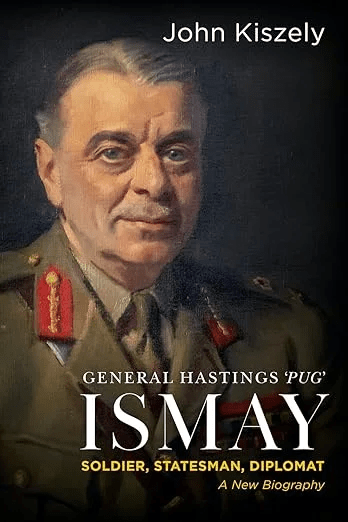
Review by Max Hastings in The Sunday Times 26 May 2024
One day in April 1941, Sir Hastings Ismay was discussing their mutual boss with a fellow general who considered him too subservient to the Prime Minister. `Pug` was impenitent, saying that he thought Churchill such a wonderful man that `if the PM came in and said he`d like to wipe his boots on me, I`d lie down and let him do it`.
From May 1940 to July 1945 Ismay was most importantly Churchill`s military chief of staff. Born in 1887, he did an apprenticeship as an Indian army cavalryman and spent most of his subsequent career as a functionary, first on the prewar Committee of Imperial Defence, then with Churchill; in 1947 as the viceroy Lord Mountbatten`s chief of staff through the partition of India; and finally as the first secretary general of NATO from 1952 to 1957.
Knighted in 1940, Ismay was a great public servant, driven by an almost obsessive sense of duty. Unlike many British grandees, especially the army chief Alan Brooke, he understood the importance of getting on with the Americans and never condescended to them. His supposed resemblance to a certain sort of dog earned him his affectionate nickname at a young age.
He handled Churchill brilliantly, enduring his irrationality, sometimes abuse, at the cost of several breakdowns precipitated by exhaustion. The general himself described his experience as well as any man could, in a 1944 letter to his wife, at a time when he was being battered by the service chiefs of staff as well as by Britain`s leader:
`Things are about as difficult, and delicate, as they have ever been. Whatever job the post-war years have in store for me, nothing will induce me to continue to be a go-between, and a mirror of other people`s opinions, or to be vested with a certain amount of authority but no executive responsibility. It has been a very hard five years, and the hardest part has been the necessity of keeping my “place” and my temper, and the prohibition against forming my own view, and fighting my own battles.`
At one point he told his secretary: `I can`t take any more of this` – Churchill`s intemperance, that is – `I`ve told the prime minister I am going to resign.` He withdrew his letter, of course, and `the Master` said sorry – sort of. But his role as peacemaker, especially between British and American warlords, was never less than stressful. Ismay became the British soldier whom Eisenhower trusted more than any other, as is testified by their many exchanges of personal letters.
John Kiszely, a distinguished soldier, has performed an important service by writing this book, which should resurrect the reputation of Ismay, today almost forgotten, as one of the critical figures in the British war machine. His emollience caused Churchill more than once to shout `appeaser!` at him. The Tory MP Brendan Bracken described Ismay as `Winston`s nannie`, and once sought to silence him by saying: `Shut up, you chutney-eating general!`
The prime minister spent more time alone with Ismay than anyone outside his family, and the general went to his grave without disclosing much of what was said between them. He told Harold Nicholson of Churchill: `When things are going well, he is good; when things are going badly, he is superb; but when things are going half-well, he is hell on earth.`
When VE day came King George VI joked that there should be a photograph of himself, Ismay and the cabinet secretary Lord Bridges, as the only three important British figures who had kept their jobs since 1939. Churchill said to his chief of staff as he left downing Street after his election defeat, `We`ve had a damn good gallop for five and a half years,` but Ismay`s verdict might have been more equivocal.
For all the general`s workaholic habits, he was no ascetic. Intensely clubbable, he loved food, wine, racing and parties. Rich through his wife, he owned a substantial estate and took his own butler to Paris for the NATO job. There is speculation that he conducted an affair with his wartime assistant Joan Bright, who for some time lodged in his London flat after being bombed out of her own. There is no evidence, however, beyond affectionate letters: `God bless you, darling…Much love, Pug.`
He was prone to occasional lapses of judgment, of which the most notable was a proposal, supposedly approved by Churchill, that he should parachute into France during the 1940 blitzkrieg and fight with the British army. Mature reflection caused him to drop this crazy notion. Kiszely also suggests that Ismay may have erred in failing to ring alarm bells about Mountbatten`s disastrous Dieppe raid in August 1942.
A fascinating part of this biography addresses the general`s key role behind Mountbatten, in managing Indian independence. He went into the job with an exaggerated respect for the viceroy`s powers, and also perhaps for his own. There was never a bloodless way for the British to quit India. The two men could claim no higher achievement than a least bad exit, without much honour or glory.
Ismay, like many others, learnt that Mountbatten`s conceit considerably exceeded his intelligence, although his showmanship had real value. He recoiled from Mountbatten`s callous insouciance in the face of communal violence, writing to his wife: `There is human misery on a colossal scale around me – and millions are bereaved, destitute, homeless and worst of all desperately anxious and almost hopeless about their future.`
And it is hard to know whether to laugh or cry on reading that while the chief of staff was working 17 hours a day on the partition of India, Churchill blithely dispatched to him for correction drafts of the first volume of his memoirs.. His sleepwalking former aide somehow made time to comply.
The author inflicts one disappointment on readers, by asserting here that Ismay, as secretary general of NATO, never delivered the famous line attributed to him – that the organisation`s job was to `keep the Russians out, the Americans in and the Germans down`. Nonetheless the general made a remarkable contribution to transforming the NATO treaty into a working military alliance.
Britain was fortunate to have such men as Ismay in the wartime corridors of power, and it is tragic that they exist no longer. A considerable part of his success must have derived from decades of experience close to the summits of power, such as no modern general or bureaucrat can acquire. Moreover, almost all 21st-century politicians treat officials with an indifference trending towards contempt, which drives out men and women of quality.
Ismay died in 1965 loaded with honours having seldom, if ever, committed an indiscretion. He was not gifted with the highest intelligence – Kiszely writes that `there was much about Ismay that was quite ordinary`. But he had common sense and a profound decency that made him a great servant of the Greatest Englishman.
—————————————

Review by Allan Mallinson in Country Life 12 June 2024
Churchill admirers are wont to excuse his mistakes in the First World war – the Dardanelles campaign in particular – by saying he learned from them and put that to good use in the Second. I take a different view, that Churchill`s attempts to open a second front in 1915 was the only bit of inspired strategic thinking in the war, that it was botched by the professionals` timidity and that the subsequent campaign at Gallipoli was further botched by military incompetence of a high order. That an effective war-cabinet machinery and chiefs of staff committee could have meant success makes the failure all the more lamentable. These were not Churchill`s mistakes, but he had been well placed to observe them. When he became prime minister in May 1940, he understood how war should be made, just as the Duke of Wellington had always said that he`s learned how to do, things by observing how not to.
Critical to this was selection of the right people. In this respect. Gen Sir Alan Brooke – afterwards Field Marshal Lord Alanbrooke – chief of the imperial general staff from 1941 to 1946, is perhaps the most famous. Gen Sir Hastings (later Lord) Ismay is far less known, yet, as Churchill`s principal staff officer – with whom he developed the closest of personal relations – he was at the heart of the matter of allied strategy in a way that the executors, the chiefs of staff, were not always. To understand the Second World War fully, you have to follow `Pug` Ismay`s trail. The author, Lt-Gen Sir John Kiszely, a decorated Falklands veteran and former assistant chief of the defence staff, has the priceless advantage of many years` observing at first hand how things should and should not be done. The book is, quite simply, indispensable, nor have I seen a better indexed one.
The story does not stop in 1945, however,. The new prime minister, Clement Attlee, had also seen Ismay at work. `Pug`, a former Indian cavalry officer, became chief of staff to Lord Mountbatten during Partition and Independence. When Churchill returned to power in 1951, he made him Secretary of State for Commonwealth Relations and, the following year nominated him to be Nato`s first secretary general, a post he held for five years – all this achieved by a man who failed to get into Cambridge and went to Sandhurst instead. The `failure` would seem to beg a question for today`s Britain.
————————————
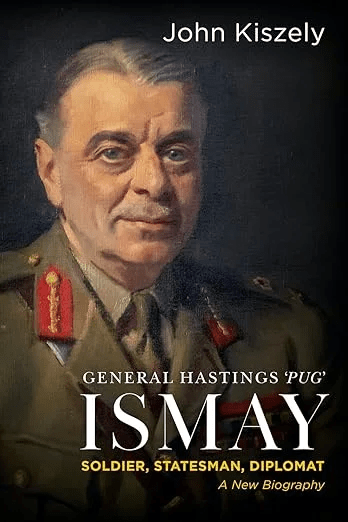
Review by Paul de Zulueta in The Guards Magazine Summer 2024
There were many distinguished men and women who served the great cause that was the Second World War but few have remained household names. They have been kept in the shadows, eclipsed by Churchill’s extraordinary wartime leadership and eternal self -publicists like ‘Monty’ and Mountbatten. This wonderful biography by the distinguished former Scots Guardsman, John Kiszely, is the story of the life of General Hastings Ismay, wartime chief staff officer to Churchill and the first Secretary General of NATO. As an historical record of our nation’s ‘finest hour’, it is gripping and beautifully researched; as a study of a human being at the centre of momentous events, quite compelling.
Awarded the DSO for his leadership leading the Camel Corps against Mullah Mohammad Abdullah in Somaliland in 1919, Ismay rejoined his Indian Army regiment, on the North-west Frontier. Kiszely recounts an incident that portrays Ismay’s moral courage, the human attribute that outweighs its physical trait. One of his regiment’s Indian officers applied for membership of the rarefied Rawalpindi Club and was blackballed. Ismay gathered his fellow officers together and said, ‘ Look chaps, we’re all resigning from the club tonight, I’m dammed if I’ll belong to a club where a brother officer is blackballed.’ He won the day.
After staff college at Quetta, it was clear that Ismay was ‘ an officer of exceptional merit.’ But merit in itself does not guarantee the highest reaches of the Army. As Kiszely points out, Ismay studied every aspect of his profession. He attended the RAF Staff College at Andover in 1924, his grasp of air power seen as slightly eccentric then, but vital to our war effort some 15 years later. Ambitious young officers in the British Army would do well to study Ismay’s apprenticeship in the profession of arms. And perhaps, more importantly, Ismay’s ability to read people and pour a liberal amount of soothing oil on fractured relationships as inter-Service rivalry worsened in the late 30s and at the outbreak of war. As an aside, Field Marshal Lord Guthrie wrote in his memoirs that he would often keep quiet during heated discussions but offer to summarise the discussion and then use the opportunity to press home his own opinion. It was a ploy Ismay used throughout his career as he mastered the corridors of power.
For a variety of reasons Ismay was never to have a command appointment. His talent for staff work and ability to apply himself to the most complex of problems were too much in demand. He caught Churchill’s eye who appointed him as his chief staff officer. Throughout the war, Ismay was at the heart of decision -making, reporting directly to Churchill as Prime Minister and Minister of Defence. They got on well. Churchill’s mercurial brilliance had to be balanced by Ismay’s calmness and composure.
Kiszely has peppered his biography with wonderful anecdotes. There was the famous exchange, now perhaps forgotten, between Weygand, the French Minister of War and Churchill, where Weygand urged Churchill to commit all our fighter aircraft to France. Churchill refused. He knew when the decisive moment would be. Not the battle to save France, but the Battle of Britain. Ismay was to remark that it was ‘the greatest decision Winston took during the war.’
The early years of the war before Britain had even approached ‘ the end of the beginning’ were unnerving and fraught. Churchill firing off bursts of verbal machine gun fire, ‘ if we lose Egypt, blood will flow, I will have firing parties and shoot the generals.’ Kiszely conveys the tension with pace and admirable balance. For example, the loss of Singapore in February 1942 was an unmitigated disaster. Ismay, as a former Secretary to the Committee of Imperial Defence, should have known that Singapore’s defences all faced a sea – borne attack. The Japanese bounced through the Malayan Jungle taking Singapore within days. Churchill berated Ismay, ‘you must have known the position, why didn’t you tell me?’
It’s a myth to think the ‘ broad sunlit uplands’ were within our grasp after Pearl Harbour and the Americans entered the war. There was goodwill but a certain amount of distrust between the high commands of both countries. Once again, Ismay had to wheel out the oil can to smooth things over. He became a trusted and close friend of Eisenhower who was to become the Supreme Allied Commander on D -Day. Ismay’s workload would have felled most men and it nearly did for him. Kiszely, again, never loses sight of the human story in his biography of Ismay, without which the book would lose a lot of its strength. This was particularly true during ‘ the year of destiny’ that was 1944. Ismay`s word portrait of Stalin at the various Allied conferences is haunting, a terrifying and murderous man behind his ‘ Uncle Joe’ mask. And like Putin, quietly spoken.
Given the confusion and shambles of the High Command structure in the Falklands campaign and in Afghanistan, it’s surprising that we failed to learn from Ismay’s ‘ handling machine’ that converted thought into action. It’s a constant theme in this excellent biography where the reader is left with the feeling that no one has paid much attention to institutional memory, the same old mistakes…..
By the end of the war, Ismay had more than filled ‘ the unforgiving minute with sixty seconds’ worth of distance run.’ But the transition from war to peace and Indian independence with its controversial partition still needed men and women of experience and judgement. As Ismay wrote, ‘ the idea of emerging from my newfound retirement and getting involved in the last chapter of British rule in India was singularly unattractive. On the other hand, I owed so much to India that it was my bounden duty to lend a hand.’ And it was some hand he leant to Mountbatten as his chief of staff. Ismay saw that Mountbatten was undoubtedly a man of charisma and energy but one whose political and strategic judgement were rarely sound; witness his decision to divide the Indian Army on ethnic grounds. The partition of India into the Republic of India and the Islamic Republic of Pakistan led to human misery, mayhem and murder on a huge scale, a failing invariably downplayed by Mountbatten.
The last chapter of Ismay’s life was as important as any. He was to become the first Secretary General of NATO, then comprising 14 nations ( 32 today). Ismay had to tread carefully and deploy all his skills of tact and diplomacy, not helped by Monty who in a speech about nuclear weapons said, ‘ I would use the weapons first and ask afterwards.’
There’s a quote about Ismay who reputedly said, ‘ The primary purpose of NATO is to keep the Russians out, the Americans in and the Germans down.’ Kiszely is quite right to nail this as a highly unlikely remark for Ismay to have made. Kiszely knows the character of the man.
The final word should go to Eisenhower who said of Ismay, ‘ his name may be forgotten ; but the contribution he made to winning the war was equal to many whose names became household words.’
Kiszely’s book Anatomy of a Campaign, the British Fiasco in Norway was first-rate. This biography is outstanding and is the front rank of biographies, military or otherwise.
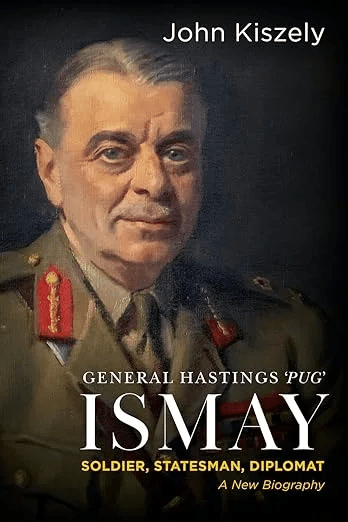
Review by Francis P Sempa in Asian Review of Books, 27 August 2024
When thinking about the most important World War II generals on the Allied side, the name Hastings Ismay does not come immediately to mind. But it should. Throughout the war, he was Winston Churchill’s right arm, serving as his chief staff officer in the Defense Ministry, Deputy Secretary of the War Cabinet, and as a member of the Chiefs of Staff Committee. General Ismay accompanied Churchill on his trips to France early in the war, and later accompanied Churchill on summit meetings with other Allied leaders. And he was “instrumental”, writes John Kiszely, a forty-year veteran of the British Army and a visiting professor at King’s College and visiting research fellow at Oxford, in his magnificent new biography of Ismay, “in designing and managing the ‘handling machine’ that converted the Prime Minister’s decisions into action”.
Long before World War II, Hastings Ismay was, Kiszely writes, a “child of the Raj”, meaning that his “roots were in India and in the British governance of it”. His mother was born in India, so were his grandparents on his mother’s side.
He grew up in a family most of whose members were closely involved in [the British Raj’s] management and dedicated to its purpose. All six of his maternal aunts and uncles had grown up in India … The family was steeped in the self-perceived institutional ethos and values of the Indian Civil Service.
Duty, honor, loyalty, and a belief in the civilizing obligation of the British Empire were among those values. The members of the Indian Civil Service, Kiszely writes, never saw themselves as oppressors or exploiters of their colonial subjects—though many of their subjects begged to differ.
In 1900, Ismay was shipped-off to a boarding school in England (Charterhouse School in Surrey), then trained at the Royal Military College at Sandhurst, which Churchill had also attended. After Sandhurst, he was sent to India to serve in the Gloucestershire Regiment, north of Delhi in the Punjab. Later, he joined the 21st Cavalry which was based on the North-West Frontier near the Kyber Pass and the Afghan border. It was there that his fellow officers gave him a nickname that stuck: “Pug”. He saw combat in the 1908 Mohmand Expedition, a six-week campaign against raiding parties of the Mohmand tribe that terrorized border villages. And, Kiszely notes, Ismay began to read voraciously—Gibbon, Kipling, and Churchill’s River War. From 1914 to 1920, while many of his fellow officers and friends were fighting in Europe, Ismay served in a Camel Corps that chased and fought against the “Mad Mullah” (Muhammad Abdullah Hassan) and his jihadist followers in British Somaliland. In five years and four separate campaigns, British forces, including elements of the Royal Air Force, defeated the jihadists, but the Mad Mullah escaped capture, later dying of influenza.
After holidaying in England and marrying Kathleen “Darry” Clegg, Ismay returned to India. Soon he was sent to Simla, the Himalayan headquarters of the Indian Army. Ismay’s star was rising. He was soon back in London, appointed as assistant secretary of the Committee of Imperial Defence (CID). This committee, Kiszely notes, was where military policy and strategy were formulated and developed. Here, Ismay rubbed shoulders with service chiefs, government ministers, generals, admirals, and other military and civilian experts. It was when Ismay worked on that committee that he first met Churchill, who was then serving as Chancellor of the Exchequer. Here, Ismay also got a taste of the inter-service rivalries that plagued the British defense establishment.
His next assignment was as head of Military Intelligence at the War Office. He was now a colonel. He reported to General John Dill, who greatly valued Ismay’s work and who would cross paths with Ismay again during the Second World War. In 1936, as war clouds gathered over Europe, Ismay returned to the CID, where he discovered that Churchill was mostly right about British defense deficiencies. In 1938, with war on the horizon, Major General Ismay was named head of the CID, where he worked to establish a much-needed ministry of supply. When war broke out, he became the military’s Deputy Secretary of the War Cabinet.
Kiszely shows that during the next five years, Ismay was indispensable to Churchill, especially as a go-between with the British Chiefs of Staff and later when America joined the war, with the Combined Chiefs of Staff. Churchill constantly fought with the British chiefs, and the British chiefs constantly fought with their American counterparts. Ismay was quite often the calm voice of reason that helped to hold the alliance together. He established good relations with US Generals Marshall and Eisenhower. Ismay often worked 18-hour days filled with what Kiszely describes as “unremitting hard slogging and pressure”. Churchill later wrote that Ismay and he “became hand in glove and much more.”
After the war, an exhausted Ismay was called back to India to help General Mountbatten implement the end of British rule there and the partition of the country between India and Pakistan. Ismay met often with Nehru, Gandhi and Jinnah in futile efforts to conclude a peaceful partition. He found this work to be even more exhausting than World War II, as civil strife led to hundreds of thousands of deaths in clashes between Hindus and Muslims. When he returned to England, he helped Churchill with the writing of his World War II memoirs. And when Churchill once again became Prime Minister in the early 1950s, he tapped Ismay to be Secretary General of NATO, a position he held for five years. He later became a member of the House of Lords.
Ismay was a pallbearer at Churchill’s funeral in January 1965. Ismay died in December of that year. Kiszely credits Ismay’s achievements to his “sense of duty and service, honour, loyalty and patriotism”, which he traces to his upbringing in India. Kiszely shows that this “child of the Raj” helped Winston Churchill save Western civilization.
——————————————-

Review by Albert Palazzo in Australian Army Research Centre`s Land Power Forum 24 March 2021
Periodically, one is fortunate to read a book that ticks all the boxes. It is interesting, impeccably written, and professionally relevant — a page turner that you just can’t put down. The kind of book that when you reach the end you think, ‘why did I not read this sooner’ or ask ‘what else has this author written’? John Kiszely’s Anatomy of a Campaign: The British Fiasco in Norway, 1940, is such a rare and exceptional book.
Anatomy of a Campaign is about how to direct war, not how to fight it. Kiszely’s focus is on the British political and military leadership at the highest levels and the decision process the War Cabinet and Service Chiefs used to decided for and manage the 1940 campaign in Norway. It is a story of strategy and the nexus between the political and military spheres. Kiszely’s story is also one of hubris, incompetence and delusion, traits that were all too rampant among British decision-makers. The German preparation for and conquest of Norway is considered but only to demonstrate how a campaign should be planned and run. The book’s analysis of battle is limited to broad brush strokes and only sufficient to illustrate the results of higher decisions.
Kiszely identifies two main factors that determined the campaign’s outcome: the German dominance of the air and British lack of actionable intelligence. Indeed these were critical factors, but he goes further. Of equal importance to the German control of the air was the British failure to accept that the opening of the Third Dimension had changed the character of war. They simply did not appreciate the potential for airpower in a tactical role. On the intelligence front it was not a lack of reporting on enemy intentions but an absence of a body to coordinate all the intelligence sources and to provide timely analysis. A contributing factor to the intelligence failure was an inability to imagine what the enemy could or would do, an institutional complacency that reflected a complete disregard of the ‘other’ in war.
The Allied campaign in Norway was a coalition effort, but little in its conduct suggests an awareness of the necessity to coordinate actions. The governance between the British and French was hesitant; both Great Powers treated the Norwegians with disdain. But then the British Service Chiefs also did not act in a joint manner, with each service pursuing their own war. Today such coordination is taken for granted. It shouldn’t because the course of this campaign shows how easy it is for allies and services to advance their own organisations preferences when firm political direction is lacking.
The list of British incompetence identified is so extensive that even the most ardent anglophile will be forced to reassess their faith. The Chiefs, William Ironside (Army), Dudley Pound (Royal Navy) and Cyril Newall (Royal Air Force) consistently failed to provide honest advice to the War Cabinet and instead preferred to advance the interests of their own service. When the War Cabinet advanced a hare-brained idea the Chiefs were not forthright in explaining the risks in implementation. The Prime Minister, Neville Chamberlain, prioritised cabinet equanimity over effectiveness while avoiding hard decisions or the necessary reigning-in of a manic Winston Churchill. War Cabinet meetings too often descended into politicians moving companies around maps, with the Service Chiefs encouraging their fantasies. The result is a depiction of a broken government detached from reality, which also explains why the Chamberlain government was in its final days.
This is an important book for soldiers of any rank and its reading should be mandatory, and more than once. At staff colleges it should be featured as the basis of role-playing workshops. Politicians, who aspire to the offices of the prime minister, treasury or defence, as well as their staffs, should also be provided with copies, as should senior bureaucrats. War is a serious business and all of the British mistakes were avoidable. Anatomy of a Campaign demonstrates what can go wrong in war when it is run by amateurs. We should all take heed.
———————————
Review by GH Bennett in The British Journal of Military History Volume 6, No 1, 2020
It is, perhaps, an interesting reflection on the nature of military history that this reader opened Kiszely’s book expecting to find a new, but at the same time very traditional, assessment of the British campaign in Norway in 1940. That expectation was increased on reading that the author is a former senior officer in the British Army. It is to Kiszely’s great credit that his book perfectly demonstrates the maxim that appearances and expectations can be highly deceptive. Anatomy of a Campaign is an extensive and deep inquiry into the reasons for the failure of the British intervention in Norway. It does not attempt to give a comprehensive account of the campaign and seeks to look beyond the obvious causes of failure which might be reduced down to ‘poor strategy, intelligence blunders, German air superiority, the weak performance of the troops involved and serious errors of judgement by those responsible for the higher direction of the war’ [p.viii.]. Instead, Kiszely wants to look at the deeper reasons for these problems: To the British way of war in the early part of the Second World War, and to the reasons why the decision makers took the decisions that they did. Kiszely’s book is thus both an interesting fresh set of insights into the Norwegian campaign (overshadowed in popular memory and much of the writing about the Second World War by the German assault on the Low Countries and France), but also serves as an inquiry by case study into the higher political and military management of theBritish war effort.
Kiszely carefully charts the planning processes and structures by which the critical decisions on the Norway campaign were taken; the multiple layers through which the campaign was shaped from War Cabinet to the Military Coordination Committee and the Chiefs of Staff Committee. The picture which emerges is of a planning process into which structural delay, of fudged decisions and inter-departmental conflict was inbuilt and inevitable. Power to take vital action was not concentrated and checks rather than balances handicapped the speed at which Britain could wage war at the highest level. Britain was a country at war, but Whitehall still clung to much of the culture and practices of the pre-war period. Where reasonably possible, the risk of damage to private property was to be avoided in target planning for the early phases of the bombing campaign against Germany, and the Admiralty telephone switchboard closed down for the weekend at noon on Saturdays. In the War Office civil servants concluded departmental business at 17.00 hrs. prompt. For some, the war was a part time affair and gentlemanly standards were to be maintained come what may.
At the apex of the decision-making process stood a War Cabinet with ‘a very limited understanding of strategy’ [p.39.]. The image of Neville Chamberlain as a leader unable to provide strong leadership is confirmed and Kiszely charts the myriad rifts between ambitious ministers and service chiefs: between the glorious self-educated “expertise” of the politicians and the quieter professionalism of the service chiefs. In the Admiralty, the First Sea Lord, Dudley Pound busied himself in deflecting and defusing some of the more adventurous schemes of Winston Churchill. This was in preference to a more confrontational approach to the bold ideas on how to wage war by the civilian head of the department. Personal issues amplified the structural and cultural weaknesses in the senior management of the British war effort. Pound, for example, had perhaps been a less than stellar choice as First Sea Lord, and Churchill’s behaviour and thinking on Norway was conditioned by the disaster of the Dardanelles in 1915. Chief of the Air Staff, Air Chief Marshal Sir Cyril Newall comes across as rather diffident and reserved, while the appointment in September 1939 of General Sir Edmund Ironside as Chief of the Imperial General Staff, came as a surprise to a professional soldier who had little experience in the War Office. The tensions within the departments of government, and the tensions between the services, made for inertia and compromise in war planning which, in the case of the Norway campaign, would prove fatal.
Instead of a key move as part of a coordinated grand strategy the Norwegian campaign broke down into a series of separate air, sea, and land operations. Desperate improvisation was no substitute for sound planning. The ways in which compromised decisions and processes in Whitehall played out on the battlefield for British forces, despite some tactical success in theatre, is ably charted by the author who concludes with a wide-ranging assessment of the significance of the Norwegian campaign including the fall of Neville Chamberlain as Prime Minister.
Kiszely’s book is ground breaking and of considerable value in understanding British war making in the early stages of the Second World War. It is also written in an engaging and open style that should ensure wide readership. The depth of research is evident, and the text is well supported with supporting material. Anatomy of a Campaign: The British Fiasco in Norway, 1940well deserves the plaudits which have been heaped upon it with, no doubt, more to come in the future.
——————————————————
Review by Dr. James Corum, in US Army War College Quarterly, `Parameters`, Volume 48, No 3, Autumn 2018
The campaign in Norway, which lasted from April to June 1940, is one of the understudied campaigns of World War II. After all, Norway never assumed the decisive importance that both the Germans and the British thought it would have. After the German offensive in the west in May 1940, it was seen as something of a sideshow. Yet the Norwegian campaign highlights an incredible level of deficiencies in the British wartime command and control system at the strategic, operational, and tactical levels at the outset of the war. It was a campaign that the British, French, and Norwegian forces might well have won if only they had possessed a basic competence in joint operations and a command system capable of effective and rapid planning and response. Unfortunately, the Germans possessed an effective command system and understanding of operational warfare in 1940 while the British did not.
Retired Lieutenant General John P. Kiszely, an officer with an impressive background in command and higher staff positions, has written about the 1940 campaign in Norway with a new perspective that focuses on British leadership and command. Few historians would have the insights into the personalities of high command that General Kiszely has, simply because the author spent years in the senior staffs in Whitehall and has a clear understanding of what commanders need to know and do. Thus, his analysis, based on a careful reading of the minutes of the staff conferences, is pretty damning in terms of the performance of Britain’s military chiefs in April and May 1940.
In this thoroughly researched and documented study, General Kiszely dissects the campaign and explains how the world’s top navy, alongside a very capable air force and a less capable army, could fail so badly. A British campaign that included poor planning, muddled decision-making, failed coalition operations, and a lack of any operational concept or interservice cooperation plagued the allies from the start. The title describing the British fight in Norway as a “fiasco” is apt, and in Kiszely’s analysis none of the major British strategic players—the service chiefs, the military staffs, the war cabinet and First Lord of the Admiralty Sir Winston Churchill—performed well.
Both the Germans and the British saw Norway as strategically important, and the military staffs of both countries began planning for major operations there in December 1939. The contrast in planning is remarkable. The German navy, Luftwaffe, and army staffs worked closely together, understanding this campaign would be the first campaign in warfare in which all three services would play a major and essential role. The German plan identified the forces to be allocated, which included almost all the German navy’s surface fleet, a few recently raised infantry divisions not needed for the upcoming spring offensive, and a sizeable and well-balanced air component. German operational planning anticipated some of the obvious requirements of the campaign. Widely separated task forces would require a lot of communications, and the Germans built a considerable signals force into their initial landing plan. A joint operation would require close interservice cooperation, and the German staffs established an effective liaison and command system under a theater headquarters. At the lower level, the German army task forces ensured they had a good mix of supporting arms, especially antiaircraft and engineers, in the first attack wave.
The contrast with the British approach to planning is striking. At the lower levels, the British Army planning for deploying forces to Norway were abysmal. Little thought was given to ensuring adequate communications, liaison with the other services, or in ensuring adequate antiaircraft cover. In short, pretty basic stuff was ignored. There was no British theater headquarters or commander, and when the fight came, the different British landing forces in central Norway and Narvik all reported to different commanders in London.
On paper the British seemed prepared for joint warfare. Britain had the Military Coordination Committee with some exceptionally capable officers assigned to it. But at this stage of the war, the committee had no real staff and limited powers, and its role had not been clearly defined. The war cabinet providing strategic policy was too large to be effective. Interservice rivalry was intense. Poor communications kept the military chiefs in London in the dark about the conditions in Norway. The British did not appoint a senior liaison officer to the Norwegian Army and this onsiderable force, eager and ready to fight, was virtually ignored in British operations. The British effort at the tactical level included some successes in the fight for central Norway and in the Royal Navy’s destruction of ten German destroyers at Narvik. But the confused headquarters in London failed to exploit tactical success.
General Kiszely demonstrates how the personalities of the service chiefs can have a decisive impact on a campaign. In the case of the British service chiefs, all were seasoned professionals with good reputations, but none were perfect, and all exhibited serious flaws in their command style. Admiral of the Fleet, Sir Dudley Pound, was already worn out and exhibited little interest in issues that did not directly involve his service. Chief of the Air Staff Sir Cyril Newall was known as a talented administrator, but had a weak understanding of doctrine and operations. Like Pound, he declined to get involved in issues of joint operations. Chief of the Imperial General Staff Sir Edmund Ironside had a superb military record but had always served as a field commander, had never served on the senior staff, and had no experience in strategic level planning. The senior officers of each service well knew much better candidates for these jobs were available.
The technology of war has greatly changed since 1940, but the human aspects including the essentials of command, planning, and coordination have not changed. This is why I highly recommend this book as essential reading for all military officers and civilian leaders to understand the dynamics of decision-making, operational planning, and execution in modern conflict. As we have learned from some recent conflicts, experienced and highly educated senior officers can get campaign planning and execution horribly wrong. Sometimes we need to highlight a campaign that offers some concentrated lessons on the basics of senior leadership and organization.
—————————–
Review by Richard P Hallion in Air Power History December 2018
A retired lieutenant general of the British Army, Kiszely has written what is undoubtedly the definitive history of the ill-fated Norwegian campaign. As one reads it, it is quickly evident why it received the Royal United Services Institute for Defence Studies’ prestigious Duke of Wellington Medal for Military History, presented yearly for the best English language writing on military history.
Anatomy of a Campaign is a thoughtful, sobering, and, indeed, damning account of how unfounded prewar and wartime assumptions; intelligence failures; political and military miscalculation; inadequate and questionable strategy; multiple liaison and communication failures; deficiencies in doctrine, equipment, logistics, and training; poor operational and tactical execution; and, above all, failure to appreciate and use air power properly, led to disaster. Overall, Kiszely’s book, a volume in the Cambridge Military History series, adds further luster to a highly regarded series of impeccably researched and written works.
Kiszely employs a chronological framework, but within this, he discusses and digresses on a wide range of issues offering insights, information, and assessments that speak highly of his research. His bibliography constitutes a superb reference for anyone studying the early history of the Second World War in Western and Northern Europe, and his source notes will feed and assist the scholarship of historians who may seek to explore in greater detail individual parts and issues of the story that he tells.
Unlike many historians who often lose themselves in narrow discussions of individual tactical actions, he ranges freely and widely over the battlespace, covering the decisions, actions (and their consequences) of individuals at the senior, operational, and tactical levels of planning and war. An appendix of the dramatis personae of September 1939 to June 1940, is surprisingly useful in keeping people and their positions straight. Kiszely is fair but unsparing in his judgments: Prime Minister Chamberlain’s “great disadvantage was not that he did not know the answers but that he did not know enough about the subject [military affairs] to know the right questions to ask.” General Sir Edmund Ironside, the Chief of the Imperial General Staff (CIGS) was “totally miscast as CIGS,” prone to “erratic judgment,” and “constantly rejecting the warnings of his staff and the Joint Planners.” The Army, Air Force, and Navy chiefs “were not of the highest quality,” and “made a poor team.” Too little prewar thought was given to joint and combined operations so that, when war erupted in 1939, all three British services were deficient in joint doctrine, training, and experience and in combined operations with potential allies. This latter was a constant source of frustration, and resulted in national forces—British, Norwegian, French, Polish—often having to go-it-alone against an enemy who, if not perfect, was nevertheless perfectly instructed and comfortable with joint operations.
At times, Kiszely’s account is darkly comic and would be almost funny if one did not keep in mind the sobering reality of killed, wounded, and captured soldiers, sailors, and airmen, and destroyed ships, planes, and equipment. In perhaps the most bizarre episode of the campaign, the aircraft carrier Glorious was caught by the German battlecruisers Scharnhorst and Gneisenau and sunk (together with two destroyers) with great loss of life, all because its captain, a submariner by training and experience, was racing to make a court-martial in Scotland and didn’t bother to have any of his aircraft scouting around the ships.
Overall, Kiszely concludes that while the Allied campaign failed most obviously at the tactical level, the outcome was decided at the grand-strategic and operational levels. Allied lack of appreciation for what the German Luftwaffe could accomplish—quickly seizing air superiority, moving 2300 tons of supplies and 29,000 troops from Germany to Norway using 500 transport aircraft (mostly the ubiquitous Junkers Ju 52-3m), sinking ships at sea, and undertaking punishing bombing strikes of Allied forces and positions—highlighted prewar failures not only by the British Army and Royal Navy, but by the Royal Air Force’s own leadership as well. “Britain’s command of the sea, on which the campaign strategy from the outset had rested, was shown not to extend to inshore waters dominated by Germany’s command of the air,” Kiszely concludes.
In sum, Kiszely, whose historical judgments and insights draw freely on his extensive experience as a military commander at the highest levels of NATO, offers a cautionary tale that commanders today at all levels would be well advised to read and ponder, given the challenges faced in Asia, the Mid-East and—again—in Northern Europe, particularly the Baltic. This is a book that should find a home on the shelves of any officer assigned to joint and combined planning: the lessons presented here, cogently argued and thoroughly documented, are enduring ones.
———————————
Review by Lars Saunes in US Naval War College Review, Vol 72, No 1 (Winter 2019)
https://digital-commons.usnwc.edu/nwc-review/vol72/iss1/13/
————————————————
Review by Charles Dick in British Army Review
Number 176, Winter 2018
Anyone who thought the Crimean War was the nadir of British ineptitude in war should study Sir John Kiszely’s fine analysis of the Norwegian campaign of April-June 1940. As they do so they may find some echoes in Britain’s recent as well as more distant past.
By mid-December 1939, there was a groundswell of opposition to the Anglo- French strategy of strategic defence against Germany until such time as economic blockade had gravely weakened Germany’s ability and will to continue the war. In the governments of both countries, there were demands that ‘something must be done’. In Britain, these were led by Winston Churchill at the Admiralty. He believed that interrupting the export of
Swedish iron ore via the port of Narvik would be a critical blow to Germany’s war economy: indeed, he was to champion not only an invasion of northern Norway but also of Sweden to seize the mines
themselves. Riding roughshod over doubts and objections, the proposed violations of neutrality and the resultant consequences internationally, Churchill cajoled and bullied Prime Minister Chamberlain, the War Cabinet and the initially unenthusiastic Chiefs of Staff into falling in
behind the scheme. The Soviet invasion of Finland added weight to the demand for intervention. In late March French prime minister Reynaud, was to propose an even more ludicrous project to cripple the German economy; the destruction of its ally Russia’s Caucasian oil wells, a task which the
Allied Air Forces said could be largely accomplished by 177 bombers (flying from unspecified bases).
There was much discussion and argument, lasting for about three months, within political and military circles about the scope and scale of the Scandinavian expedition. There was no questioning the wisdom of the policy, nor agreement on the strategy by which it was to be accomplished and the enemy’s capabilities were hardly considered. The one voice of realism, that of the Joint Planning Staff, was ignored. Then, following the surrender of Finland, the operation was cancelled. That was not the end of the matter. Political pressure for action again built up and before long the Narvik operation was on again. Unfortunately for the British, the Germans struck first. On 9 April, they simultaneously invaded Denmark and Norway.
Apart from some initial work in December, German planning took less than four weeks. It was done on a joint basis, grounded in good
intelligence. It envisaged a concurrent seizure of key ports from Narvik to Oslo by forces tailored to the task and a rapid build up, especially in the air. Faced with overwhelming British naval superiority, it relied on surprise, boldness, speed, agility and inter-service cooperation within a simple and clear chain of command acting according to an effective doctrine. Pre- emption and surprise conferred the initiative and the Germans retained it throughout in a high tempo operation in which they enjoyed air superiority from beginning to end.
Throughout the seven week campaign, British reactions were belated and strategically inept. Their forces were inadequate both in strength and capability. They acted according to plans that were largely improvised. Having failed to contest southern Norway and lost the battle for the critical
centre, they persisted with their efforts in the north long after the strategic rationale had disappeared. The campaign was only aborted as the evacuation from Dunkirk was beginning.
Such is a precis of events that John Kiszely sets out with admirable clarity and economy. His explanatory detail reveals the full awfulness of the blunders and incompetence that the British, especially the Army, displayed. While the catalogue of British failure and German success is interesting in and of itself, the more compelling aspect of the story is the exploration of why
the contrast is so stark. It highlights the frequent and deleterious effects that a period of peace, even a short one, often exercises on a democracy’s ability to understand and wage war. And it explores an oft-repeated failure of the British military to adjust its ideas to the changing nature of war and
to ensure that adequate leaders are at the helm of the three armed services.
The author adduces various reasons for defeat, most of them inexcusable. The essentially dubious nature of the policy objective was not challenged and the strategy for achieving it was ill-considered because it was formulated without taking into account either the friction inevitable in war or the fact that the (grossly underestimated) enemy had a vote too. Then there was the poor state of the armed forces after two decades of neglect. Worse, their inadequacies were not taken into account in decision-making. Worse still, the British never took a holistic view of the campaign, regarding it instead as a series of separate and discrete operations without prioritising clearly and
consistently between them or even, until too late, creating a workable, properly staffed, chain of command. This latter problem existed at the highest level, with decisions left to an overly bureaucratic, ponderous system of committees that guaranteed that they would be arrived at late
after much futile, often acrimonious discussion that exhausted their members.
Who was responsible for the shambles? The prime minister, Neville Chamberlain, did not understand military matters and did not choose a war cabinet that made up for his deficiency. Each of the chiefs was ignorant of evolving German capabilities and intenton pursuing their single service interests. There was a voice of informed opinion available in the
form of the Joint Planning Staff. It was consistently ignored by the chiefs. Consequently, the government lacked sound and coherent advice based on understanding and foresight. Political and military decisions alike were based on a pervasive unreality.
John Kiszely subjects all these issues and more to penetrating and dispassionate analysis. In doing so he brings to bear the judgement of a soldier with both experience of combat and real understanding of the demands of strategy and the difficulties of working at the highest levels of
the political/ military machine. Moreover, he explores this catalogue of catastrophe with clarity, economy and refreshing flashes of sardonic humour. He has written something far more important than a mere history of a campaign, though it is excellent as such. This book is a warning to the current and future generations about the consequences of failure to understand the nature of contemporary war, of strategy or the enemy. His penultimate paragraph makes the point. ‘In sum, as so often after a long period of peace, British military capacity, in its widest sense, faced the audit of war and was to be found wanting. The result was a fiasco – a textbook example of how not
to plan and conduct a military campaign.’ The British intervention in Norway was not only a sorry tale but also, as the author so tellingly points out, a cautionary one.
—————————-
Review by Nigel Jones in The Times Literary Supplement 6 October 2017
On May 7, 1940 the diminutive senior Tory backbencher Leo Amery rose in the House of Commons to speak in an adjournment debate on Britain`s first campaign of the Second World War. The attempt to foil Hitler`s sudden devastating attack on Norway had rapidly dwindled from a mere reverse into what General John Kiszely calls a “fiasco”, and Amery did not mince his words.
After eviscerating the government led by the son of his own mentor Joseph Chamberlain for its feeble and incompetent conduct of the war, Amery quoted Oliver Cromwell`s words in dismissing the Long Parliament (another administration that had outlived its purpose): “You have sat here too long for any good you have been doing. Depart, I say, and let us have done with you. In the name of God, go!”
Amery`s dramatic intervention administered the coup de grace to Neville Chamberlain`s tottering premiership. Although the National Government had an unassailable majority and technically won the debate, Amery`s speech was instrumental in persuading almost eighty Conservative MPs to rebel by abstaining or voting with the Opposition. Within three days, Chamberlain was out and Winston Churchill was Prime Minister, with a single-minded determination to avoid a looming defeat and, eventually, to win the war.
As Kiszely points out in his admirable analysis of the Norway campaign, it was Churchill, the chief beneficiary of the fiasco, who, as First Lord of the Admiralty, bore, at least in part, ministerial responsibility for the disaster. Although, unlike Chamberlain, Churchill knew what war was about, wanted to win it, and relished conflict with almost unseemly glee, the Norwegian campaign played to his most glaring faults: his impetuosity, his bullying military commanders to take decisions they knew were wrong, and his secret nagging need for a victory to cancel out his responsibility for another amphibious disaster in the First World War: Gallipoli. “The Norwegian campaign was not”, Kiszely concludes starkly, “…his finest hour.”
Kiszely advances a host of reasons for the campaign`s failure: including confusion about aims; reactive rather than proactive responses to enemy moves; a lack of co-ordination between Army, Navy and Air Force and with Britain`s French and Norwegian allies; and Chamberlain`s dithering habit of postponing action and running the war by committee. Kiszely calculates that the Service Chiefs had to attend a staggering ninety-two meetings in April alone, when they would have been better employed running the campaign.
Kiszely castigates the confusion among the Allies caused by Hitler`s lightning invasion, and their belated and piecemeal reaction, while pointing out that in the long term the Fuhrer`s apparent stunning success cost Germany dear: half her surface feet was lost off Norway, arguably making the invasion of Britain impossible; and tying down 400,000 men sorely needed elsewhere in garrisoning a country with a 1,000-mile coastline.
As former Assistant Chief of the Defence Staff, turned academic military historian, General Kiszely writes whereof he knows. (One wonders how many unnecessary committee hours he chalked up in his forty-year military career.) Perhaps as a consequence of issuing orders his prose has a refreshing clarity not always apparent in academic history, and this book must surely stand as the definitive account of a minor campaign with major consequences for the rest of the war.`
————————————–
Review by Allan Mallinson in The Spectator spectator.co.uk/…/the-disaster-of-norway-1940-anatomy-of-a-campaign-reviewed
Review by Williamson Murray in Joint Force Quarterly
Review by James Davis in Grounded Curiosity
September 2018
Book Review – Anatomy of a Campaign
Review by Niall Barr in The Journal of the Royal United Services Institute
Volume 163, Number 1, March 2018
On 4 April 1940, the British prime minister used a phrase which would return to haunt him with particular force. In a speech to Conservative MPs, Neville Chamberlain claimed that Adolf Hitler had ‘missed the bus’. Just five days later, in a highly bold and risky venture, German forces overwhelmed both Denmark and Norway in a rapid air, land and sea assault. The governments and chiefs of staff of both Britain and France were completely wrong-footed by Operation Weserübung. Chamberlain was forced to eat his words while desperately attempting to improvise a response.
The Allied campaign in response was a misbegotten, woeful affair that gave the lie to any British or French presumption of superiority in strategic or operational decision-making. After a series of naval actions, some of which went very much in the favour of the Royal Navy, the first British troops landed in Norway on 14 April 1940. Yet with debate over the importance of Trondheim and Narvik, British efforts were fatally divided and ill-prepared. The movements against Trondheim ended in disaster and, although Narvik eventually fell to the Allies, by this time the entire campaign had become an irrelevance; France itself was about to succumb to German assault.
This important early campaign of the Second World War has not been overburdened by historical studies or analysis. In its immediate aftermath, the new prime minister, Winston Churchill, who had been one of the chief architects of the British campaign in Norway, had no wish to rake over its failings. As John Kiszely points out, no official report was produced in the immediate aftermath. While some histories of the Norwegian campaign have been produced subsequently, it has not attracted the same level of attention as many other, more famous and, let it be said, successful British campaigns of the Second World War. In short, the Norwegian campaign has long lacked a proper assessment.
Kiszely’s title is well chosen: he provides a clear and complete forensic dissection of Britain’s strategic and operational failings. Indeed, the author does not simply reveal the skeleton of British failings, but also emphasises the interactions between the military and political structures: the debate and discussion among the service chiefs and the War Cabinet. Kiszely brings to bear his considerable experience as a military officer and commander who has had his own experience of the political-military interface.
This is, in many respects, not a work of standard military history. There is no question that Kiszely writes from a British perspective: phrases such as ‘our troops’ makes this clear. That said, the author also works in the German decision-making process and perspective skilfully, with the comparison and contrast between the two protagonists often placing British failings in sharp relief. There is also something didactic about this work – Kiszely draws numerous points on wider themes of operational decision-making, strategy and policymaking. However, it is clear why this is the case; his experience as a professional military educator of senior British officers is evident in the emphasis he places upon the wider themes he draws from this campaign.
This is therefore a detailed and well-executed campaign study. The twists and turns of British policy and the military implications of such changes are very well handled and the clarity of description and analysis always useful. Kiszely pulls no punches in his analysis or criticism. In his harrowing description of the fate of the 148th Infantry Brigade, which landed at Åndalsnes with insufficient equipment and ambiguous, even contradictory, orders, he states with a soldier’s bluntness that ‘the result was a rout’ (p. 189). Indeed, his analysis of the shortcomings of Britain’s strategic decision-making and operational flaws are searing and consistently hit their mark. Of Churchill, to whom Chamberlain tended to defer on strategic questions, Kiszely points out acidly, that ‘[as] a strategist, whether professional or amateur, [he] was not necessarily a good strategist’ (p. 214). In the contemporary era, when almost everyone in the field of defence and security seeks to claim strategic expertise, his point is well made.
There are many dramatis personae in this sorry tale, many of whom were soon eclipsed by more famous successors. Indeed, when most people today think of British strategy-making in the Second World War, it seems almost natural to consider Churchill and Alan Brooke, not Chamberlain and Edmund Ironside. Ironside emerges as a professional head of the army who is madly busy, tied up in endless meetings and discussions, yet also clearly well out of his depth. It is hard not to feel some sympathy for him. As Kiszely mentions, there is, surely, a heavy irony in the fact that Churchill came to power on the back of this fiasco for which he was largely, if not solely, responsible. Churchill would be remembered while Ironside, among others, would be forgotten as ‘guilty men’.
There is another irony in that, while the British adventure in Norway may be ‘a textbook example of how not to plan and conduct a military campaign’ (p. 299), Kiszely’s work is a model of how to analyse the political, strategic and operational dimensions of such a campaign. As such, it provides a great deal to ponder on the nature of war and decision-making. In an era when the UK seems to have abandoned the attempt to produce official history and analyses of past campaigns, Kiszely’s work demonstrates the value of assessing the key failures and lessons of military campaigns. His analysis also holds up a mirror, albeit indirectly, to contemporary British defence policy and military capability. The reflection is not always a comfortable one. Seventy-eight years on from the events, Anatomy of a Campaign provides an object lesson in the follies of wishful thinking and strategic assumptions when they are not backed by military preparedness.
——————–
Review by Sebastian H Lukasik in The Journal of Military History
Volume 22, Issue 3, July 2018
Largely overshadowed by the series of world-changing events that took place
in France and the Low Countries in May and June 1940, the Norwegian campaign of the Second World War rarely merits more than a few paragraphs in general histories of that conflict. It has, however, inspired a significant body of specialized studies dedicated to analyzing various elements of this fascinating and complex episode. A showcase of the larger problems that dogged the western Allies’ initial conduct of the war, the Norwegian campaign was the first operation directly to pit British and French forces against those of Nazi Germany in battle, the war’s first truly tri-service operation, and the first campaign in which airpower proved a central, if not the most important, influence on the ultimate outcome.
John Kiszely’s fine book does not dispute earlier assessments’ collective portrayal of the Allies’ Scandinavian adventure as an unmitigated disaster. A retired lieutenant-general in the British army with a long record of distinguished service in Northern Ireland, the Balkans, and Iraq, Kiszely affirms that judgement by characterizing the campaign as “a textbook example of how not to plan and conduct a military campaign” (p. 299). What is original, however, is his approach and his overarching argument. Most scholars have explained the Norwegian disaster with reference to failures of Allied intelligence to predict German designs on Norway, Germany’s superiority in the air, Allied ground troops’ sub-par tactical performance, and the questionable decisions made by Britain’s senior political and military leaders. Kiszely acknowledges the importance of these factors, but argues that the British fiasco in Norway was the result not just of real-time failures, but ultimately of long-term systemic flaws in the mechanisms that senior decisionmakers employed to plan and execute the operation.
The main source of these flaws lay in the committee-based framework for managing the higher direction of the war in general and of the campaign in particular. The Scandinavian venture was conceived and conducted through the interplay of several committees, at whose apex stood the War Cabinet. Though well-suited to the direction of a protracted conflict, this system— one that privileged consensusbuilding and conflict-avoidance among principals, rather than rigorous strategic calculation—proved completely inadequate for dealing with fast-paced crises such as the Norwegian campaign. Committee meetings and bureaucratic procedure consumed enormous amounts of service chiefs’ and government ministers’ time. Worse, this arrangement distracted senior leaders’ attention from what really mattered: the need for an intellectually honest and analytically rigorous appraisal of how individual operations fit into and facilitated broader strategic and policy objectives. As Kiszely demonstrates again and again, senior leaders’ “attention became fixated on what to do next and on eye-catching tactical schemes” regardless of their coherence or strategic value (pp. 277–78).
The implications were dismal. The campaign really consisted of three poorly coordinated operations, with no unified commander appointed to impose some sort of coherence over them. In fact, effective unified command was conspicuous by its absence even within individual operations. At Narvik, for example, command of the joint naval-ground task force was initially split between two flag officers who heartily detested each other (pp. 135–38). Complicating things even further was the tendency of high-level leaders back in London to micromanage tactical and operational problems that should have been left for in-theatre commanders to deal with. The proclivity that First Lord of the Admiralty Winston Churchill displayed for giving tactical advice to local commanders exemplified this problem, and was by no means the only example of this unfortunate trend (p. 145).
Grounded in an impressive array of primary sources, Kiszely dissects British decision-making processes with relentless logic and a keenly analytical eye. The detail and insight with which he analyzes what was, for the Allies, a foretaste of the even more bitter defeats to come later that year makes this book an important addition to the historiography of the early phases of the Second World War in Europe.
Sebastian H. Lukasik Air Command and Staff College
Maxwell Air Force Base, Alabama
——————
Review by Simon Doughty in The Guards Magazine, October 2017
There is a common theme among modern military history books to focus, almost exclusively, on battles and campaigns from the perspective of those who are actually engaged in the fighting. While this is a perfectly respectable genre, and one that has become particularly popular, it is also an approach that can fail to answer the important questions about the campaign itself. Not so much how a campaign was fought at the tactical level, a question that can be answered by studying the methods, training and equipment available to the opposing armies, but why it was fought in the first place, and its real purpose. The political decisions, the professional military advice, the application of lessons from previous wars, so often ignored or misinterpreted – these are all the questions that can be overlooked by those authors who are too quick to get themselves down to the fighting itself.
In this masterful study of the disastrous Norway campaign of 1940, John Kiszely gets swiftly to the centre of the Whitehall machine and how it functioned, or failed to, in the early months of the Second World War. Following the outbreak of war in September 1939, there was a strange period known as the Phoney War when the British Expeditionary Force deployed to familiar places in France and Flanders, and with a certain air of deja vu. Trenches were dug, the Army continued its training with inadequate forces and equipment, preparing for…nobody was quite sure. Back in London, it was almost a case of business as usual, with peacetime working hours still being observed and a War Cabinet presided over by Neville Chamberlain, a competent committee chairman but hardly a war leader.
The dominant member of the War Cabinet at that time was, of course, Winston Churchill. Now back as First Lord of the Admiralty, the same post he had held in 1914, it did not take Churchill long to start proposing ideas aimed at relentlessly taking the war to the enemy, exactly as he had done 25 years earlier. The problem, as John Kiszely demonstrates so clearly in this excellent book, is that Whitehall simply did not have a decision-making machine that could maximise Churchill`s qualities while preventing his charismatic style and force of character from leading the War Cabinet to places it should not have gone.
There is, of course, a sense of history repeating itself. Churchill argued persuasively for the Dardanelles Expedition in early 1915 as an alternative way of prosecuting the war away from the stalemate of the trenches. Although the Dardanelles ended in disaster, the War Cabinet would have needed even less persuasion in 1940 for such an imaginative approach, and seemed more than capable of flawed decision-making, without asking the right questions, or, crucially, receiving sound advice. Kiszely quotes Michael Howard`s observation that for those involved in the higher direction of the Second World War `”never again” was not just an epitaph; it had become a guiding principle of strategy`. It was certainly not the simplistic answer that was needed.
So, when Churchill proposed a daring operation to cut off the supply of Swedish iron ore shipped through Narvik to Germany, the War Cabinet was receptive, although it subsequently wavered and changed its mind on more than one occasion, losing much time and initiative in the process. Churchill`s stirring radio addresses had proved good for morale, and with the Royal Navy`s early success at the Battle of the River plate, his star was in the ascendant. Churchill had opposed appeasement in the 1930s, and had more experience than other members of the War Cabinet, and a vision that looked way beyond the tactical level. He could not be ignored.
The problem at this stage, as the author explains so well, was that neither the Government nor its professional military advisers were ready or prepared for running a war. The three Service Chiefs of Staff, all at the tail-end of their careers, seemed to be consumed with single-service issues and rivalries to the extent that these often overshadowed the higher direction of the war. The concept of combined operations involving the three services was in its infancy, and the Chiefs of Staff were not capable of speaking with one voice on any issue of strategic importance. Military advice was so often lacking in clarity, leaving the War Cabinet at the mercy of its most forceful and talented member.
War Cabinet deliberations on Norway were soon overtaken by events, with the Germans managing to achieve complete strategic surprise by launching attacks along the Norwegian coastline in April 1940. The British and French allies had now lost the initiative, and were soon embroiled in battles at sea and on land that were doomed from the outset. The Norwegian campaign failed most obviously at the tactical level, for many reasons, but the seeds of failure had been sown before the troops or ships had even left harbour. While the Germans were able to conduct their campaign as a series of coordinated military operations aimed at delivering a clear strategic objective, for the Allies it was nothing short of a muddle from beginning to end. As just one of many examples, Kiszely cites the Germans` coordinated logistical plan to deliver large numbers of troops, equipment and combat supplies for the campaign, observing that “it is difficult to envisage their British opponents accomplishing this even without an enemy”. It is quite an indictment, but is well supported by the evidence,
The Germans did have some advantages over their enemy. They did not have to worry about public opinion back home, nor the more tiresome aspects of working within a coalition. However, as the author describes so clearly, their strengths in no way explain the weaknesses in the British way of war in those early months of 1940. Churchill later wrote that “Considering the prominent part I played in these events, it is a miracle I survived”. He certainly did survive, and was soon to be Prime Minister, as a direct consequence of the failure of the Norway campaign.
This book is more than history because it has an enduring relevance which, perhaps alarmingly, will find parallels with recent campaigns. In writing the book, John Kiszely has applied all his experience as a commander, and as a senior staff officer in the Ministry of Defence. He has applied, throughout, a thorough and analytical approach, to produce a book which is both readable and incisive. He has sought to answer some difficult questions, and has not been tempted to blame the usual suspects such as lack of intelligence, the strength of German airpower, or the poor performance of the Allied forces assigned to the operation. The failure was much more fundamental than that. This disastrous campaign came early in the war, and might have been forgotten as gradually the British and their allies learnt from their mistakes. However, it is important that such failures are mot forgotten.
Anatomy of a Campaign. The British Fiasco in Norway, 1940 is an excellent book which lives up splendidly to its title. While it will be of professional interest to serving personnel, providing a fascinating insight into campaign planning and the relationship between grand strategy and the employment of military resources, there is another obvious audience for this excellent analysis: politicians and civil servants.
Review by General Sverre Diesen, former Chief of Defence of Norway, in Norwegian Military Journal (Norsk Militaert Tidsskrift). October 2017
This reviewer has read several accounts, both Norwegian and international, about the British campaign in Norway in 1940. Nevertheless, I have yet to come across one which is as thorough in its recording of the events, as comprehensive in its analysis, and as ruthless in its allocation of responsibility for the failures of the campaign. As such, the title, Anatomy of a Campaign, is well chosen, as one sometimes has the feeling of being present at a military-historic autopsy.
The underlying, structural and human causes
General Kiszely’s ambition with Anatomy of a Campaign: The British Fiasco in Norway 1940 is not to uncover unknown facts of the British campaign in Norway. As he points out in the introduction, there is no lack of British literature om the topic, nor is there much disagreement about the causes of the failure: failed strategy, neglect of intelligence, German air superiority, weak performance by participating units, and fatal mistakes made by political and military leaders in London. Kiszely’s project is to find out why and how so many terrible decisions could be made. In other words, he is not looking to retell the story and summarize yet again the obvious mistakes that were made; he wishes to detect the underlying structural and human causes leading to the failure of the campaign. This will hopefully contribute to the avoidance of similar disasters in the future which might otherwise well happen to all of us.
To find the answers, Kiszely begins with the British leadership in 1939, analysing both organisation, processes and the somewhat diverse gallery of personalities. Because, as he notes, “military campaigns begin long before the first shot is fired. Indeed, before the first shot is fired, the outcome of the campaign may be largely preordained”. Bearing in mind this insight, and with the gradual revelation of the basic weaknesses of British military capacity for waging modern war in 1939, one is tempted to say that any other result would have taken a miracle. There were, for example, four different councils and committees concerned with the formulation of strategy. In the Supreme War Council, French and British prime ministers met with their key military advisers to coordinate the allied war effort. Secondly, the inner core of the British government, the War Cabinet, constituted a national war council. Under this was the Military Coordination Committee, where ministers in the three military departments – the War Office for the Army, the Admiralty of the Royal Navy and the Air Ministry of the Royal Air Force – tried to coordinate the advice from the three service chiefs. And finally, the chiefs of the three branches were supported by their respective staff and the Chiefs of Staff Committee. As one can imagine, this was not the best point of departure for the quick and efficient making of strategy.
The Purpose
With the description of the organizational conditions as a starting point, we follow the British-French leaders’ discussions about Scandinavia through the autumn of 1939 and the winter of 1940, a time when there was an opportunity for the allied forces to strike a decisive blow to the German war economy by stopping the Swedish export of iron from the Norwegian ice-free port of Narvik. However, as it would still be possible to ship the iron from the Swedish port of Luleå on the Baltic during the summer months, a move into northern Sweden to take direct control of the mines at Gällivare was considered. The most ambitious alternative included sending forces to Trondheim, Bergen and Stavanger, as well as the deployment of large forces to southern Sweden to defend Scandinavia against the probable ensuing German invasion. In addition to this, the Allies had a genuine wish to come to Finlands aid in the Winter War against Stalin`s Soviet Union, which would have made it possible to combine a transit to Finland from Narvik through Northern Sweden with the occupation of the mines. With assistance to Finland as the lead motive, Norwegian and Swedish compliance was also thought to be more likely, to the extent their wishes were taken into account.
In reality, such an ambition was both politically and militarily impossible, given the situation of the Allies during the winter of 1939-1940. The necessary forces for such an operation either did not exist, or would have to be redeployed from the continent, consequently weakening the forces there. Furthermore, the units in question were also from the Territorial Army, an organisation made up of part-time soldiers who were neither trained nor fit for modern warfare, especially not under Scandinavian winter conditions. Nor was it possible to deploy the necessary supporting units of air defence, artillery, logistics and other arms and services. This was all pointed out by the Joint Planning Committee, supported by the service chiefs, but to no avail. Incidentally, the Joint Planning Committee was the only body among the bewildering jungle of committees emerging from the the planning and execution of the campaign with some credit, unfortunately without anybody listening.
However, the top level British and French leaders proved to be incapable of coming up with a decision, even after weeks and months of deliberation, and in the end, no plans were put into action. Finland surrendered on 12 March, and the entire Scandinavian enterprise was put on the back burner, assigned forces being stood down and plans binned. Instead, it was the Germans, with their lightening strike against Norway and Denmark on 9 April, who would seize and retain the initiative during the campaign that followed. Despite the many indications that the Germans would take actions in Scandinavia, and despite the fact that such an operation required moving a significant forces to Norway across a sea controlled by the Royal Navy, the Germans achieved complete strategic surprise. In the meantime, the British had reverted to Churchill’s original idea to stop the ore transport by laying mines along parts of the Norwegian leads and force the ore ships out of Norwegian territorial waters where they could be sunk. Now they had to deal with a very different and far more serious problem.
The course of action decided upon was to improvise, based on the plan for laying the mines which also contained a land component. This included three brigades landing at Narvik, Trondheim, Bergen and Stavanger at the first sign of a German attack in response to the minelaying. However, this is a good example of Kiszely’s perhaps most important point: that with the absence of a comprehensive, well thought-out and feasible British strategy no one had a clear idea about what the purpose of these landings would be other than getting ashore, and what their mission really was when they arrived there. Add to this the complete chaos when the forces were transferred to Norway, counter-orders following orders as the tempo of the German attack changed circumstances and necessitated rapid changes of the plan. Consequently, the transport vessels were redirected to new destinations with little of no regard to their loading arrangements, causing units and their equipment to end up in different places, and with weapons in one place and ammunition in another.
The Operations
Kiszely then goes through the operations that followed at Narvik, in Trøndelag and Gudbrandsdalen. His description is excellent, not only of the British operations, but also the political and military complications of cooperation with the Norwegian and French forces. It is worth noting that he paints a different and rather more balanced picture of the events than previous British accounts, which have quite often failed to mention the involvement of other forces completely. Nor does Kiszely hesitate to blame the senior British commanders for the lack of cooperation, triggered by imperial arrogance and a lack of understanding of the fact that the Norwegian units – despite their pathetic equipment and training – could have helped the British in areas where they were even worse prepared. However, that would have required a different attitude among the British leaders from Generals Mackesy and Carton de Wiart at Narvik and in Trøndelag, to Brigadier Morgan in Gudbrandsdalen. Not only did they view their Norwegian allies as incompetent, they were also convinced that half of them were Nazi sympathisers and collaborators, mainly without any other basis than their own prejudices.
It is neither possible nor necessary in this review to give a complete account of Kiszely`s narrative of the campaign since members of the Norwegian defence community are, by and large, more familiar with these events than British or American readers. Instead, it may be appropriate to ask the question of whether Kiszely succeeds in his endeavour, which was to find the root causes of so many things failing on the British side. He does this exceptionally well and that is probably the reason why the book rises above many other accounts of the campaign. This is what makes it such an extremely valuable read, not only for those interested in military history in general, but particularly for the military reader bent on improving his or her understanding of some of the pitfalls of their profession. For example, he points out that when it was possible to ignore the many indications that a German attack on Norway was imminent, it comes back to the fragmented way in which British military intelligence was organized and worked. When it was first noted that the significant German naval forces were heading north through the Skagerrak, the Admiralty drew the conclusion that it must be a German attempt to break the blockade and penetrate the North Atlantic – not because it was objectively the only possibility . but because this was what they had been brought up to believe in – the desirability in British naval thinking of forcing their opponent to accept a decisive battle, another Trafalgar. When there was no apparatus in place to provide coordinated and consolidated intelligence assessments, the individual services subconsciously submitted to their cultural and historical assumptions – a classic cognitive trap.
Similarly, Kiszely attributes the lack of ability to provide adequate air support and protection of ground and naval forces against aircraft to a lack of understanding among a number of the senior commanders. They had failed to pay attention to how technology had developed during the inter-war period, and particularly how the air dimension had fundamentally changed modern warfare. This had catastrophic consequences, because it gave the Germans complete command of the air throughout the theatre of operations. Several factors contributed to this error: the British army’s traditional role in peace and imperial policing in which high-intensity war was really an exception; a significant element of inter-service parochialism; and sheer incompetence among key players. Military organisations are different in the sense that that they are not normally put to the test the are supposed to master everyday. As a result, they are more susceptible to developing false theories and dysfunctional characteristics than organisations in other areas of society, which interact continuously with the real world. It is precisely in the description of how fundamental human, organizational, cultural and other flaws may have fatal consequences that Anatomy of a Campaign reminds us of hw we are exposed to the same mechanisms today.
Ends, ways and means
The most fundamental of Kiszely’s critique is the British leadership’s inability to think and act strategically – that is to create a balance between ends, ways and means. On this point, his critique is scathing. Firstly, because there was no ability to see that the political goals in Scandinavia were completely detached from the resources available and the risk of pursuing them. Much of this criticism hits the government and politicians, primarily the gentle and conflict-averse Prime Minister Neville Chamberlain, who completely lacked the personality needed to lead an uncompromising war against a regime like Hitler`s Germany. Conversely, the necessary energy, ruthlessness and will were present in abundance in Winston Churchill, First Lord of the Admiralty, whose personality ensured that he came to completely dominate the discussions in the War Cabinet and the Military Coordination Committee. But, as Kiszely drily observes, ‘his exceptional powers of advocacy, and his remarkable ability to overcome opposition through a mixture of persuading, inspiring, cajoling and browbeating opponents, was not matched during this campaign by the wisdom of his judgment’. Add to this Churchill’s tendency to let his enormous commitment lead to tactical-level micro-management, as well as his total ignorance and lack of interest in logistics, and the conclusion is that Churchill must take a great deal of the blame for the British defeat. In this perspective, it is a paradox that it was the fiasco in Norway that led to Chamberlain’s resignation as prime minister and his replacement by Churchill – something Churchill later acknowledged.
A lot of Kiszely’s criticism is also directed at the three service chiefs. General Edmund Ironside, Admiral Dudley Pound and Air Marshal Cyril Newall, who could, after all, be expected to be professional warriors and strategists. They should have been a corrective to the impetuous Churchill and the other politicians when they presented impossible ambitions or impractical plans. However, despite having endless meetings in the various committees, and despite grumblings about the shortcomings of their political masters, they did not manage to put things right. This was particularly because they lacked the moral courage to tell the politicians the unpopular truth to their faces, and partly because they did not have the strategic insight expected from officers in their exalted positions. Nor did they understand that the formulation of strategy requires a real, political-military discourse, not just slavishly designing the best possible military answer to political requirements, whether realistic or not.
Furthermore, to the extent they exercised strategic judgment, it was based on their own limited experiences and perceptions. Thus, they overlooked that strategic insight cannot be acquired through personal experience alone, even in the most comprehensive and distinguished of military careers. It requires, as Kiszely points out, `hard thinking and the deep understanding of concepts, such as strategy, that can only be acquired through rigorous study`. Add to this that their experience in the mainly single-service operations of the British armed forces throughout the British empire had made them narrow-minded spokesmen for their own services, consequently the prospects for defeating the Germans in their thoroughly joint approach to the campaign were not good. To quote one of the French officers serving with them in Trøndelag: `The British have planned this campaign as they would have planned a punitive expedition against the Zulus. Unfortunately, it is we, and not the Germans, who turn out to be the Zulus.`
As the campaign progressed, the political and military leadership’s strategic perspective unravelled completely, turning into a reactive, tactically-focused substitute for strategy as well as for operational command. This was partly due to the lack of a functioning operational headquarters to lead a unified command and to control of the Norwegian operational theatre as a whole, but also to a lack of a fundamental understanding of what strategic leadership means. Here Kiszely makes an important point: the weakness of the British forces cannot be attributed solely to poor equipment and training. Indeed, “the art of good strategy is to improve one’s position with the ways and means that are available, not to attempt to achieve what would be appropriate were better ways and means available.” In other words, you cannot aspire to more ambitious strategic goals than those that are consistent with the forces available to you.
Of course, other factors than just the leadership contributed to the disaster of the campaign – the low quality of the British units, the German forces’ professionalism at all levels, chance as an omnipresent factor in military affairs and the demanding climate and terrain prevailing throughout the theatre, reinfororced by British ignorance about Norway and Norwegian conditions. Kiszely also addresses some counter-factual speculations, and assesses whether the campaign could have developed differently, had the British made other decisions at critical moments, for example prioritising the deployment of British troops to Trøndelag instead of Narvik. However, he concludes that this would probably not have turned the tables, as long as the decisive factor for the campaign was German air supremacy. Still, here, this reviewer would have liked to see an assessment of whether northern Norway could have been held, had a defensive line been established along the line of the Tys Fjord, south of Narvik, with sufficient air support as Hurricane fighters became operational from Bardufoss towards the end of the campaign, and with the Royal Navy firmly in control of the Norwegian Sea..
Finally, Kiszely points out that while on the subject of strategy , it is an interesting fact that the conquest of Norway did not turn out to be a strategic success for the Germans, for all their tactical and operational brilliance during the campaign. The collapse of France gave them access to large ore deposits in Lorraine, and the only real strategic Norwegian resource – the merchant fleet – was already under British control. Nor did they have any other economic gain to show for the occupation; on the contrary, significant food resources had to be sent to Norway to keep the Norwegian population from starving. Furthermore, the occupation of Norway required a permanent force of 400,000 soldiers, even in the end phase of the war, when there could have been put to better use good elsewhere. And although the aviation and naval bases were important in the struggle to interdict the Murmansk, they turned out to be incapable of changing the outcome of the war.
Conclusion
All in all, Anatomy of a Campaign is an excellent analysis, and can be read with great benefit by anyone with interest in applied strategy and operations, in addition to the obligation Norwegian officers should feel to be familiar with Norwegian military history as part of their general education. This reviewer agrees with the prominent military historian Anthony Beevor (without further comparison), quoted on the cover of the book: “Unquestionably the best book on the subject”. Should there be a critical remark, slightly more comprehensive and detailed maps would have been useful, making it easier for readers without intimate knowledge of Norwegian geography and terrain to appreciate the difficulties the British forces faced. Although explained well in the text, the maps lack the information and resolution necessary or that. As for references, they are complete and excellent.
Readers who do not have the time or inclination to read three hundred pages with well-formulated and easy-to-read English, who are also familiar with the events during the campaign in Norway in 1940 can still read the concluding chapter with great benefit. This is a great summary of Kiszely’s project – how was such an abject failure possible, and what, if any, guarantees do we have of not repeating the same mistakes in future? Because, as Kiszely writes in the last sentence of the book: “The ramshackle British Campaign in Norway in 1940 may have been a sorry tale, but it is also a cautionary one”. Run to the bookstore and buy the book!
———————————————-
 johnkiszely.com